最速降下曲線-04 - "a",とは
・a,とは
最速降下曲線は,
$$
{ \Large \displaystyle
\begin{equation}
\begin{split}
x &= a ( \theta - sin \ \theta)\\
y &= a (1 - cos \ \theta) \\
\end{split}
\end{equation}
}
$$
となりました.この式はサイクロイド曲線なので,a,はサイクロイド曲線の半径となります.
では,実際に,高さHから落下し,Lまで転げ落ちる場合のaとH,Lとの関係はどうなるのでしょう?
実際のサイクロイド曲線は,
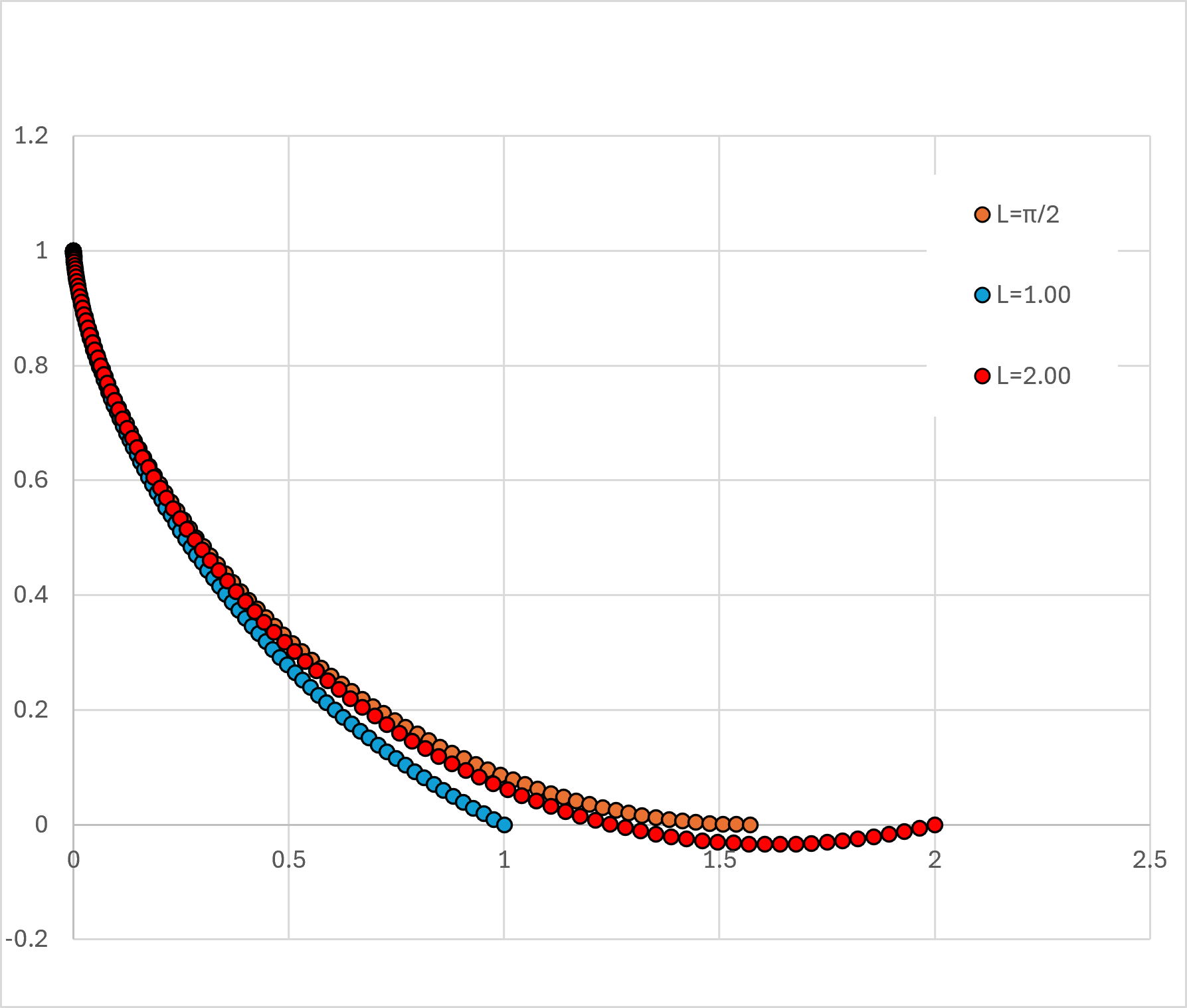
この図のように,a,を変化させることにより,
落下途中
ちょうど水平
一旦下がって上昇
など,いろいろな場合が考えられます.
高さ,到達水平距離,からaを求めたいが,どうもややこしいらしい計算になるのです(後ほど述べます)
ということで,
曲線の傾きが0となる点
を考えていきましょう..
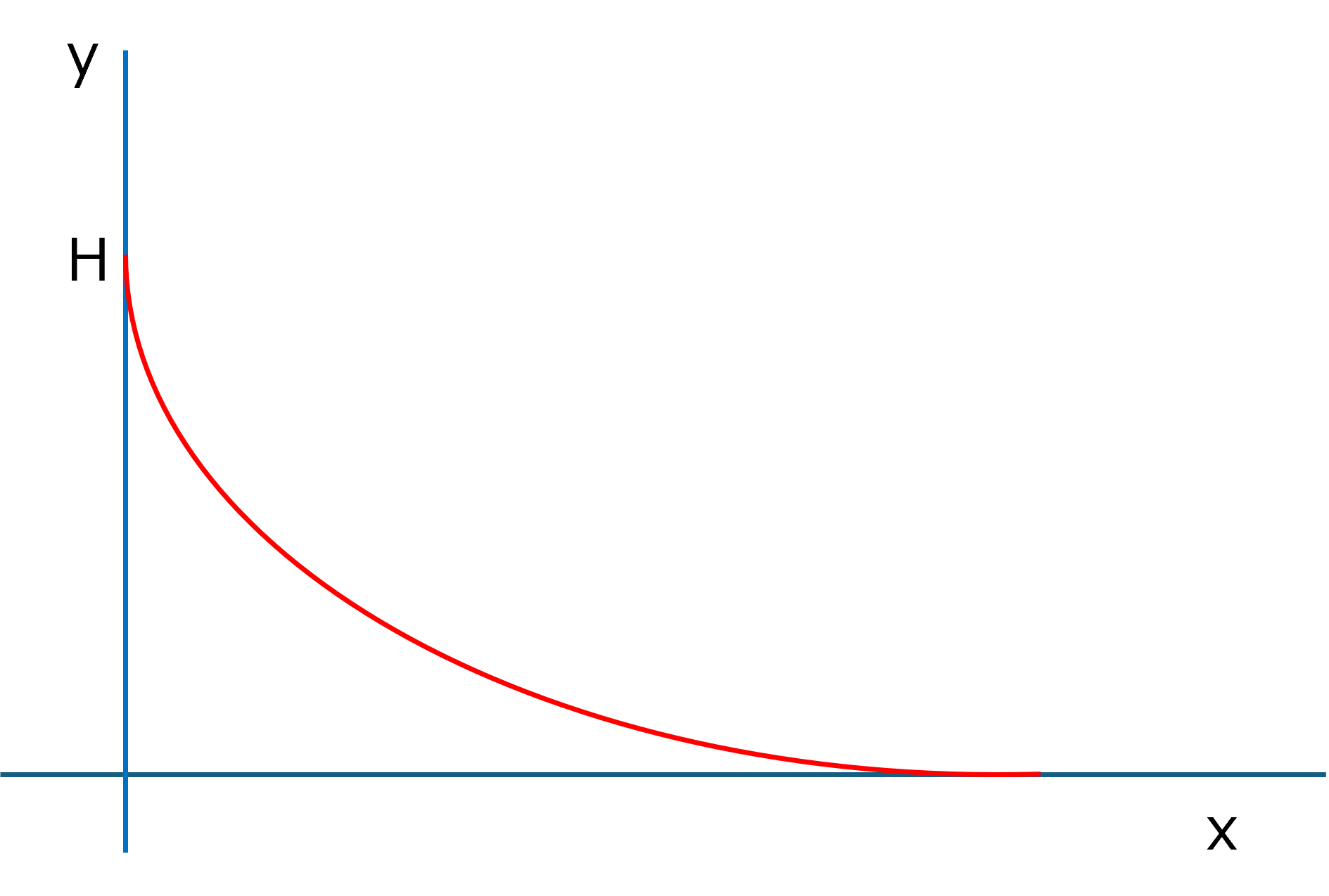
t=0,において,y=H,の場合を考えます.y軸の方向を正にとると,
$$
{ \Large \displaystyle
\begin{equation}
\begin{split}
x &= a ( \theta - sin \ \theta)\\
y &= H - a (1 - cos \ \theta) \\
\end{split}
\end{equation}
}
$$
最終地点,x=L,においては,
$$
{ \Large \displaystyle
\begin{equation}
\begin{split}
x &=L = a ( \theta_L - sin \ \theta_L)\\
y &=0 = H - a (1 - cos \ \theta_L) \\
H &= a (1 - cos \ \theta_L) \\
\end{split}
\end{equation}
}
$$
となります.曲線の傾きは,
$$
{ \Large \displaystyle
\begin{equation}
\begin{split}
\frac{dy}{dx} &= \frac{\frac{dy}{d \theta}}{\frac{dx}{d \theta}} \\
\frac{dx}{d \theta} &= a (1 - cos \ \theta)\\
\frac{dy}{d \theta} &= -a \ sin \ \theta \\
\frac{dy}{dx} &= \frac{-a \ sin \ \theta}{a (1 - cos \ \theta)} = -\frac{ sin \ \theta}{1 - cos \ \theta} \\
\end{split}
\end{equation}
}
$$
傾きは,Lの時点で0となるので,
$$
{ \Large \displaystyle
\begin{equation}
\begin{split}
\left. \frac{dy}{dx} \right|_{\theta = \theta_L} &= 0 \rightarrow sin \ \theta_L = 0 \\
\theta_L =n \pi = \pi
\end{split}
\end{equation}
}
$$
となります(1回目の水平なので,n=1)
したがって,
$$
{ \Large \displaystyle
\begin{equation}
\begin{split}
H &= a (1 - cos \ \theta_L) \\
&= a (1- (-1)) \\
&= 2a \\
a &= \frac{H}{2} \\
L &= a ( \theta_L - sin \ \theta_L)\\
&= a (\pi - 0) \\
&= \pi a \\
H &= 2a, L = \pi a \rightarrow \frac{L}{H} = \frac{ \pi}{2} \\
L &= \frac{ \pi}{2} H \\
\end{split}
\end{equation}
}
$$
と,Hを設定すれば,a,Lを求めることができます.
開始直後には,
$$
{ \Large \displaystyle
\begin{equation}
\begin{split}
\phi &= 0 \rightarrow \theta = 0 \\
\frac{dy}{dx} &= -\frac{ sin \ \theta}{1 - cos \ \theta} \\
&= -\frac{1}{tan \frac{\theta}{2} } \\
\end{split}
\end{equation}
}
$$
θ=0の時点で,分母が0となるので,傾きは-∞となります.
もちろん,最終地点においては,傾きは0となります.
到達時間は,ここ,で述べたように,
微小時間と微小速度との関係は,$ dt = ds/v $,となるので,
$$
{ \Large \displaystyle
\begin{equation}
\begin{split}
t &= \sqrt{\frac{a}{g}}\ \theta \\
\end{split}
\end{equation}
}
$$
となるので,最終地点のθはπなので,
$$
{ \Large \displaystyle
\begin{equation}
\begin{split}
T &= \sqrt{\frac{a}{g}}\ \pi \\
&=
\sqrt{\frac{H}{2g}}\ \pi \\
\end{split}
\end{equation}
}
$$
となります.
H=1 m, g=9.8 m/s2,とすると,
$$
{ \Large \displaystyle
\begin{equation}
\begin{split}
T &=
\sqrt{\frac{1}{2 \times 9.8}}\ \pi = 0.7096 \ s\\
\end{split}
\end{equation}
}
$$
となります.
次にこの場合において,直線状の傾斜を転げ落ちる場合の時間を考えていきましょう.


